|
|
Hypnotherapy for Dysautonomia
Dysautonomia is thought to affect around 70 million people worldwide, yet many people have never heard the term until they begin searching for an explanation for their own symptoms. For some people the journey to diagnosis takes years. Symptoms may be attributed to anxiety, panic attacks, IBS, hormonal changes, stress or poor physical fitness before anyone considers whether the autonomic nervous system itself is not functioning normally.
If you have been diagnosed with POTS, MCAS, ME/CFS, fibromyalgia or hypermobile Ehlers-Danlos syndrome (hEDS), there is a good chance that autonomic dysfunction also forms part of the picture. These conditions frequently overlap and share many of the same physiological mechanisms.
Can hypnotherapy help with dysautonomia?
 The Bill Frost: Changing States practice provides ADHD or ADD online hypnotherapy via Zoom and in-person hypnotherapy in High Wycombe. Sessions aim to support autonomic regulation, reduce unnecessary sympathetic arousal and help you develop calmer responses to physical triggers. Biofeedback is used with in-person sessions. Please speak to your GP first if symptoms such as dizziness, fainting, racing heart, breathlessness, chest pain or severe fatigue have not yet been properly assessed. The Bill Frost: Changing States practice provides ADHD or ADD online hypnotherapy via Zoom and in-person hypnotherapy in High Wycombe. Sessions aim to support autonomic regulation, reduce unnecessary sympathetic arousal and help you develop calmer responses to physical triggers. Biofeedback is used with in-person sessions. Please speak to your GP first if symptoms such as dizziness, fainting, racing heart, breathlessness, chest pain or severe fatigue have not yet been properly assessed.
Dysautonomia requires appropriate medical assessment and management. There is currently no single treatment that is suitable for everyone because the underlying causes and associated conditions vary considerably between individuals.
The first priority is obtaining an accurate diagnosis. Depending upon your symptoms this may involve an active stand test, tilt table testing, referral to an autonomic specialist, investigation for small fibre neuropathy or assessment for associated conditions such as POTS, MCAS or hEDS.
Medical management often includes improving hydration, increasing salt intake where appropriate, wearing compression garments, pacing activity levels, improving sleep, avoiding excessive heat and using medication when indicated. Many people experience worthwhile improvements from these measures alone.
Alongside appropriate medical care, therapy may help improve the way the autonomic nervous system responds to stress and physiological arousal. This is not about suggesting that dysautonomia is psychological. Rather, it recognises that the autonomic nervous system remains capable of learning and adapting throughout life.
Clinical hypnotherapy aims to reduce excessive sympathetic activation while strengthening the body's natural relaxation response. Many people find that regular self-hypnosis lowers physical tension, improves sleep quality and reduces the sense of being permanently "on alert". Although these approaches do not cure dysautonomia, they may help reduce the overall burden placed upon an already overloaded nervous system.
Heart rate variability biofeedback complements this approach particularly well. Slow diaphragmatic breathing, usually around five or six breaths per minute, has been shown to improve vagal activity and heart rate variability in many people. This provides an objective way of practising autonomic regulation and can easily be combined with hypnosis.
EMDR may also be appropriate when trauma has contributed to persistent autonomic hyperarousal. Some people living with chronic illness have experienced repeated medical trauma, frightening symptoms or years of not being believed. Addressing these experiences may reduce unnecessary activation of the sympathetic nervous system without implying that the medical condition itself is psychological.
NLP techniques may also help identify patterns of anticipatory anxiety, unhelpful beliefs about symptoms and behavioural responses that have developed over time. They are used to complement, rather than replace, appropriate medical care.
Some people also find carefully controlled cooling strategies helpful. Brief facial cooling can activate the diving reflex and increase parasympathetic activity. Equally important is protecting sleep. Even relatively short periods of sleep disruption can worsen autonomic regulation and increase symptom severity.
Treatment at Changing States is always tailored to the individual. Where appropriate, hypnotherapy, EMDR, NLP and biofeedback can be integrated into a broader treatment plan designed to improve autonomic regulation while working alongside your GP or medical specialist.
What is dysautonomia?
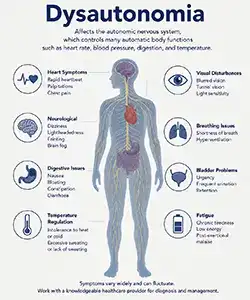 The autonomic nervous system regulates the countless processes that keep your body working automatically. Heart rate, blood pressure, breathing, digestion, body temperature, sweating, bladder function, bowel activity, pupil size, immune responses and many aspects of hormone regulation are all influenced by this system. The autonomic nervous system regulates the countless processes that keep your body working automatically. Heart rate, blood pressure, breathing, digestion, body temperature, sweating, bladder function, bowel activity, pupil size, immune responses and many aspects of hormone regulation are all influenced by this system.
Normally there is a continual balancing act between the sympathetic nervous system, which prepares the body for action, and the parasympathetic nervous system, which promotes recovery, digestion and repair. Every time you stand, eat, exercise, sleep or respond to your environment, these systems adjust automatically without you having to think about them.
Dysautonomia develops when this regulation becomes unreliable. Blood pressure and heart rate may no longer respond appropriately. Blood may collect in the lower part of the body instead of returning efficiently to the heart. Digestion may slow dramatically or become unpredictable. Temperature regulation can become poor and even relatively minor physical activity may trigger a prolonged worsening of symptoms.
Many people describe feeling as though their body is permanently working harder than it should. Standing becomes exhausting. Heat is difficult to tolerate. Sleep no longer restores energy and ordinary daily activities can require far more effort than they once did.
Although anxiety and dysautonomia can exist together, they are not the same condition. Dysautonomia is a recognised disorder of autonomic nervous system function with measurable physiological changes. Anxiety may develop as a consequence of living with unpredictable symptoms, but it should not automatically be assumed to be the cause.
Why almost every chronic illness patient has some form of it
One of the reasons dysautonomia is often overlooked is that it rarely appears on its own. Instead, it commonly accompanies other long-term medical conditions and helps explain why patients experience symptoms affecting many different parts of the body at the same time.
POTS is probably the best recognised form of dysautonomia. Instead of maintaining stable circulation on standing, the body compensates by dramatically increasing heart rate. Blood commonly pools in the legs and abdomen, reducing the amount returning to the heart and brain. Many patients report years of being told they have anxiety before a simple active stand test identifies the underlying problem.
MCAS is another condition that frequently overlaps with autonomic dysfunction. Mast cells are found throughout the body alongside autonomic nerves. When activated they release numerous inflammatory chemicals including histamine, prostaglandins and tryptase. These substances can directly influence blood vessel tone, heart rate, digestion and other autonomic functions. At the same time, autonomic stress may itself promote further mast cell activation, allowing each condition to reinforce the other.
Hypermobile Ehlers-Danlos syndrome contributes in a different way. Connective tissue helps provide strength to blood vessel walls. When connective tissue is more elastic than normal, veins may become less efficient at returning blood to the heart. Blood pooling becomes more likely and symptoms of orthostatic intolerance increase. Because of this close relationship, a diagnosis of hEDS should often prompt consideration of POTS and other forms of dysautonomia.
ME/CFS and fibromyalgia are also increasingly recognised as conditions in which autonomic dysfunction is common. Research has demonstrated reduced heart rate variability, orthostatic intolerance and small fibre neuropathy in many patients. These small nerve fibres play an important role in autonomic regulation, helping explain why symptoms can affect multiple body systems simultaneously.
The common denominator is a nervous system that struggles to regulate itself efficiently. Circulation, inflammation, energy production and autonomic signalling become closely linked. Rather than viewing each symptom separately, dysautonomia provides a framework that helps explain how apparently unrelated symptoms may arise from shared physiological processes.
Hypnotherapy related dysautonomia research and reading
| Aubert AE, Verheyden B, Beckers F, Tack J, Vandenberghe J. Cardiac autonomic regulation under hypnosis assessed by heart rate variability spectral analysis and fractal complexity. Neuropsychobiology. 2009;60(2):104-112. |
| Corrado J, Iftekhar N, Halpin S, Li M, Tarrant R, Grimaldi J, Simms A, O'Connor RJ, Casson A, Sivan M. HEART Rate Variability Biofeedback for LOng COVID Dysautonomia (HEARTLOC): results of a feasibility study. Advances in Rehabilitation Science and Practice. 2024;13:1-8. |
| De Benedittis G, Cigada M, Bianchi A, Signorini MG, Cerutti S. Autonomic changes during hypnosis: a heart rate variability power spectrum analysis as a marker of sympatho-vagal balance. International Journal of Clinical and Experimental Hypnosis. 1994;42(2):140-152. |
| Fournié C, Chouchou F, Dalleau G, Caderby T, Verkindt C, et al. Heart rate variability biofeedback in chronic disease management: a systematic review. Complementary Therapies in Medicine. 2021;60:102750. |
| Lehrer PM, Gevirtz R. Heart rate variability biofeedback: how and why does it work? Frontiers in Psychology. 2014;5:756. |
| Lehrer PM, Vaschillo E, Vaschillo B. Resonant frequency biofeedback training to increase cardiac variability: rationale and manual for training. Applied Psychophysiology and Biofeedback. 2000;25(3):177-191. |
| Moss D. The relevance of heart rate variability for hypnotherapy and psychotherapy. Brain Sciences. 2026;16(4):352. |
| Padilla VJ, Alldredge CT, Darnall BD, Jensen MP, Garland EL, Patterson DR. Heart rate variability, hypnosis, and psychotherapy. American Journal of Clinical Hypnosis. 2025. |
| Palsson OS. Hypnosis treatment of gastrointestinal disorders: a comprehensive review of the empirical evidence. American Journal of Clinical Hypnosis. 2015;58(2):134-158. |
| Peters SL, Yao CK, Philpott H, Yelland GW, Muir JG, Gibson PR. Randomised clinical trial: the efficacy of gut-directed hypnotherapy is similar to that of the low FODMAP diet for the treatment of irritable bowel syndrome. Alimentary Pharmacology & Therapeutics. 2016;44(5):447-459. |
| Porges SW. The Polyvagal Theory: Neurophysiological Foundations of Emotions, Attachment, Communication and Self-Regulation. New York: W.W. Norton; 2011. |
| Sack M, Lempa W, Steinmetz A, Lamprecht F, Hofmann A. Alterations in autonomic tone during trauma exposure using eye movement desensitization and reprocessing (EMDR): results of a preliminary investigation. Journal of Anxiety Disorders. 2008;22(7):1264-1271. |
| Schneider M, Schwerdtfeger A. Autonomic dysfunction in post-traumatic stress disorder indexed by heart rate variability: a meta-analysis. Psychological Medicine. 2020;50(12):1937-1948. |
| Whorwell PJ, Prior A, Faragher EB. Controlled trial of hypnotherapy in the treatment of severe refractory irritable bowel syndrome. Lancet. 1984;2(8414):1232-1234. |
|
