Hypnosis for Self-esteem
Self-esteem describes the way you evaluate your own worth, abilities and right to have needs. Low self-esteem often involves harsh self-criticism, difficulty accepting praise, fear of failure and a tendency to compare yourself unfavourably with other people. These patterns can affect relationships, work, decision-making and the ability to set boundaries. Low self-esteem is not a diagnosis in itself, but it commonly develops through repeated criticism, rejection, bullying, trauma or unrealistic expectations.
Can hypnotherapy help with low self-esteem?
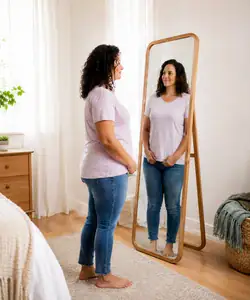 Bill Frost: Changing States offers low self-esteem online hypnotherapy via Zoom and in-person hypnotherapy in High Wycombe. Sessions seek to improve self-esteem, reduce self-critical patterns, increase confidence and strengthen personal boundaries. Speak to your GP first if symptoms could have a physical cause. Bill Frost: Changing States offers low self-esteem online hypnotherapy via Zoom and in-person hypnotherapy in High Wycombe. Sessions seek to improve self-esteem, reduce self-critical patterns, increase confidence and strengthen personal boundaries. Speak to your GP first if symptoms could have a physical cause.
Self esteem can become eroded in a number of ways over time, therefore a number of hypnosis approaches are appropriate that work at different levels.
Hypnotherapy can be used to rebuild and strengthen the factors that create self esteem: self-image, ego strength, confidence, beliefs and perceptions about past experiences.
Other techniques such as cognitive approaches both in and out of trance can install the strategies needed to maintain positive self-esteem over time. This includes managing self-talk and maintaining a positive outlook.
📄 This free RSQ Rejection Sensitivity Questionnaire explores how strongly you expect, notice and fear rejection within everyday relationships and social situations.
More about low self-esteem
We all use the expression 'self-esteem', but what do we mean by it? Some people think that self-esteem means confidence - and of course confidence comes into it - but it's rather more than that.
The fact is that there are any number of apparently confident people who can do marvellous things but who have poor self-esteem. Many people in the public eye fall into this category. Actors and comedians and singers in particular can seem to glow with assurance 'on stage', and yet off-stage many of them feel desperately insecure. Indeed, individuals can be stunningly attractive and world-famous, and seem poised and perfect - yet still, deep down, find it hard to value themselves.
If self-esteem isn't quite the same thing as confidence, what is it?
The word 'esteem' comes from a Latin word which means 'to estimate'. So, self-esteem is how you estimate yourself.
To do that you need to ask yourself certain questions:
- do I like myself?
- do I think I'm a good human being?
- am I someone deserving of love?
- do I deserve happiness?
- do I really feel - both in my mind and deep in my guts - that I'm an OK person?
People with low self-esteem find it hard to answer 'yes' to these questions. Perhaps you are one of them. If so, what can you do?
Can you improve your self-esteem?
You can begin by accepting that you are certainly not alone. Masses of people have this problem.
Secondly, you can take on board a very important fact, which is that you are a wonderful, individual and special person - and there is no one quite like you. Your fingerprints and your DNA are totally different from everybody else's - unless you happen to have an identical twin. And your mind - and how it thinks and operates - is totally your own. This means that out of six billion people in the world, you are a one-off. So if nature has bothered to make you utterly unique, don't you feel that you should accept that you're important, and that you have as much right as anyone else to be on this planet?
You have other rights too. One of them is the right to make mistakes. Don't forget that 'to err is human' and most of us do much of our learning through getting things wrong before we get them right.
Furthermore, we have the right to respect ourselves - and to be respected: this is very important. And finally - and perhaps most vitally of all - we have the right to say 'yes' or 'no' for ourselves.
Many people with poor self-esteem think that they're not very important and that their views carry no weight. Is this you? If so, try to stop these destructive thoughts; because if you go around believing them, you'll encourage other people to believe them too.
Instead, start thinking of yourself a unique person who has rights and opinions and ideas that are just as valid as anyone else's.
Testimonials
- "Without a doubt the most effective therapist I've ever come accross, wish I'd come accross him years ago!
Highly ethical, puts his clients first and probably most importantly he's broadly educated and uses evidence-based therapeutic techniques and is flexible enough to try different approaches. On top of that he doesn't take himself too seriously!
In a series of sessions we managed to deal with :-
- Getting over ongoing painful & re-occuring thoughts about a long-term relationship loss and the loss of a child - result: no more ongoing memories or emotional issues around this, fabulous!
- Childhood traumatic events that had been troubling me and poisoning family relationships and self-esteem for years - result: significantly improved family relationships & greatly improved self-esteem.
- Dealing with a long-term psycho-sexual issue. Result: no longer an issue
Don't get the idea that this type of therapy doesnt require effort, work (and/or pain at times), the difference is this actually works (well it did for me anyway!)
Couldn't recommend him highly enough!" {Relationship loss / childhood trauma / psycho-sexual issue}*
*Disclaimer required by Google: We provide testimonials to help you gain confidence about how we work and results we achieve. However, please be aware that we whilst we bring 100% of our effort and skill to the process, as with all hypnotherapy / psychotherapy practices, results may vary between individuals.
Hypnotherapy related self-esteem research
| Hurley AE. The effects of self-esteem and source credibility on self-denying prophecies. Journal of Psychology (1997) 131(6): 581-94 Self-fulfilling prophecies are a well-studied phenomenon. The study of self-denying prophecies, however, is rare. Self-denying... |
| Taylor DN. Effects of a behavioral stress-management program on anxiety, mood, self-esteem and T-cell count in HIV positive men. Psychological Reports (1995) 76(2): 451-7 This study evaluated the effects of a behavioral stress-management program on anxiety,... |
|
