|
|
Phobias and Fears
A phobia is a fear that is out of proportion to the situation that causes it and cannot be explained away. The person typically avoids the feared situation, since this helps to reduce the anxiety.
There are many things that we fear - the list below shows the top ten. A phobia is an extension of simple fear.
- fear of flying
- fear of cats
- fear of clowns
- fear of long words
- fear of heights
- fear of the dark
- fear of death
- fear of spiders
- fear of crime
Some phobias represent heightened normal anxiety towards situations that people are evolutionarily 'prepared' to fear, eg snakes, heights, sharp objects and loud noises.
In other instances, a phobia may arise by a non-threatening situation being associated with a traumatic experience. Having a car crash in Spain may lead to a phobia of Spain itself, holidays generally, driving or flying.
Rare air-crash incidents and the ambiguity that often prevails afterwards can distort public perceptions of risk and can increase the amount of fear related to flying. That can result in the development of a flying phobia.
Phobias typically occur in specific situations, eg a fear of dentists. People experience 'anticipatory anxiety' when thinking of the situation and so attempt to avoid it. They are common in the general population, but are only severe enough to prove disabling in 2 per cent of people.
Phobias are often the result of a "one time learning" process whereby a single experience is processed into a phobic response very, very quickly. This tendancy is increased if the person is stressed / anxious at the time or if the persons nervous system is being over stimulated by the effects / after effects of recreational drugs or alcohol.
Simple phobias are phobias that are specific to objects or situations. Specific phobias include:
- Animal phobias (eg dogs, snakes, spiders):
the start of these phobias is often in childhood, usually before the age of seven years.
- Blood and injury phobias:
the fear of blood tests or the sight of blood that results in fainting.
- Vertigo:
a fear of heights.
- Agoraphobia:
an intense fear of leaving the home, being in crowded spaces, travelling on public transport and being in any place that is difficult to leave. Around 75 per cent of sufferers are women, and it occurs in just under 1 per cent of people. Agoraphobia may follow a life event and be associated with a fear of 'what if it comes back while I am away from home'. It commonly occurs with panic attacks. The person may have a panic attack when outside the home and this reinforces the belief that it is safer to stay inside. Agoraphobia is often associated with depression.
- Social phobia:
a fear of social interaction with others, talking to people, eating, drinking and speaking in public. In contrast to agoraphobia, men and women are affected equally. Many people have a mixture of both agoraphobia and social phobia. Social phobia is also a common symptom of depression.
Process phobias are those that involve a sequence of events and include:
- Driving phobia generally or restricted to eg driving over bridges or on motorways
- Flying phobia - often resulting in complete avoidance of flying or anticipatory anxiety that can start as soon as the ticket is purchased
Whether a process based phobia or a simple phobia if the result is avoidance the act of avoiding the stimuli will tend to increase the levels of anxiety.
See also:
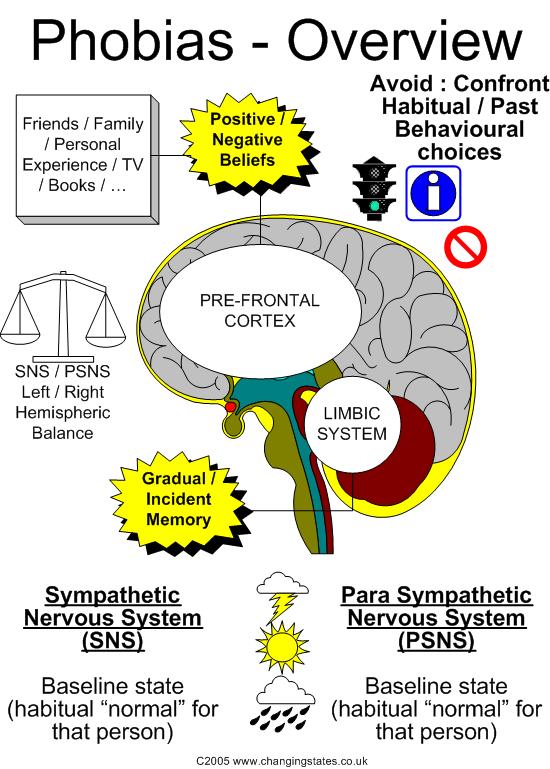
An overview of phobias
- The phobic or fearful response is learnt from family/friends or via one time learning after a particularly traumatic incident or we become gradually sensitized after a number of less traumatic experiences
- The response becomes encoded into our thinking patterns eg a invalid belief is formed, the response can also be encoded more deeply in the limbic system as something to be implicitly feared as is the case with most people's response to fire
- We avoid that we fear and begin to scan the environment for threats even when impossible eg scanning for sharks when in a desert in the case of shark phobia (based on a real case)
- We begin to experience anticipatory anxiety and this is reinforced by avoidance
- If limiting beliefs had not been formed in the early stages they tend to become evident in the latter stages eg I cannot stand being in the same room as a spider
- In our minds we see whatever is feared as being bigger than it really is (eg in the case of a spider phobia) [Vasey 2011]
- Can also include panic attacks which may evolve into panic disorder in addition to the original phobia or phobias
- As the fear response generalises other related things may also be avoided and feared, in other words one phobia can result in many phobias
All of the above interact over-time and result in the behaviour that we know as a phobia. (See diagram from this overview of key brain functions).
Research Notes
Michael W. Vasey, Michael R. Vilensky, Jacqueline H. Heath, Casaundra N. Harbaugh, Adam G. Buffington, Russell H. Fazio. It was as big as my head, I swear!. Journal of Anxiety Disorders, 2012; 26 (1): 20 DOI: 10.1016/j.janxdis.2011.08.009 https://dx.doi.org/10.1016/j.janxdis.2011.08.009
|